Analyzing Access, Equity, and Infrastructure Improvements Across the Five Boroughs
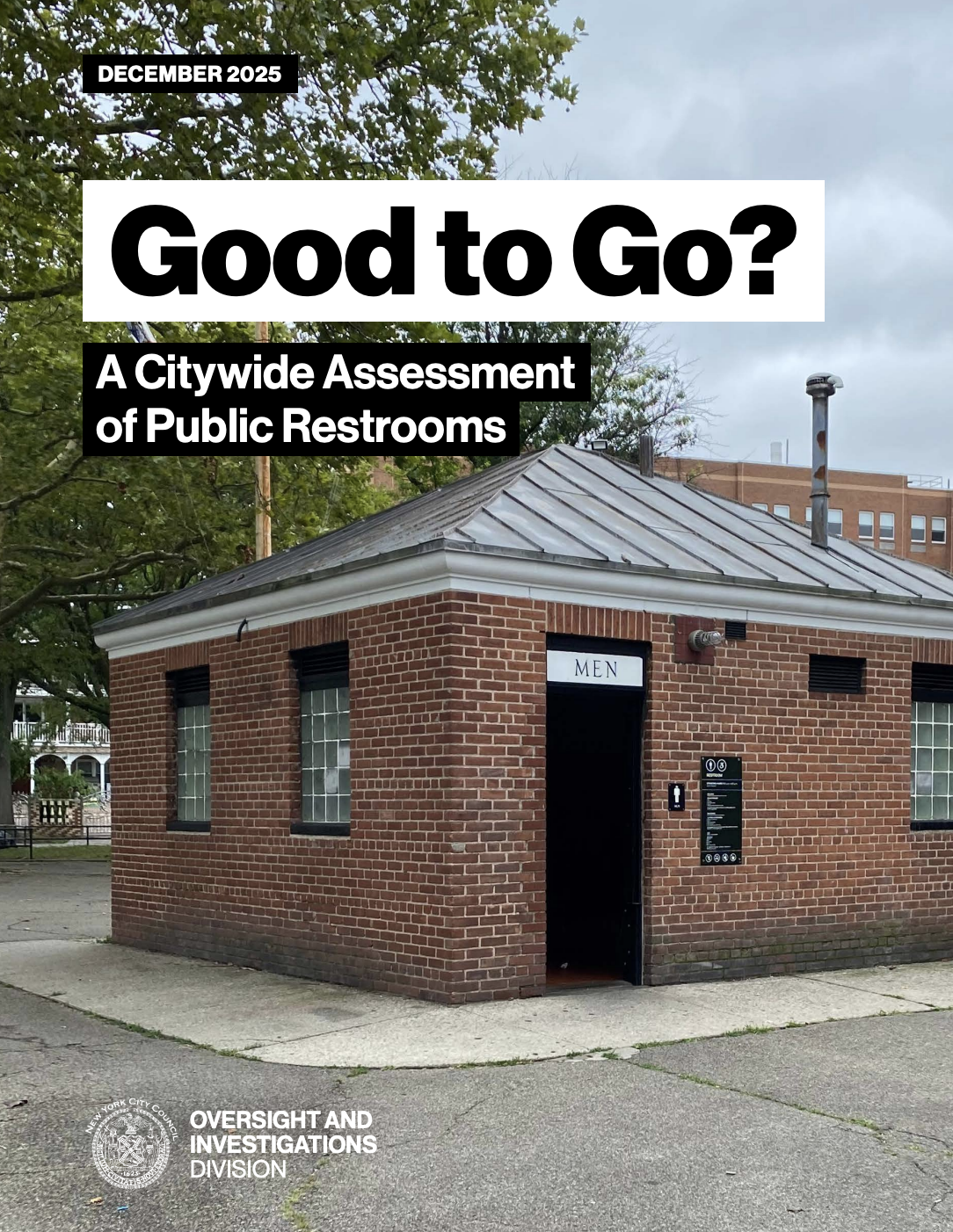
New York City, home to over 8.6 million residents, faces a significant shortfall in public restroom facilities. With 1,064 public restrooms citywide, and only 973 operational, residents and visitors often struggle to find accessible, clean, and safe restrooms. This shortage impacts public health, equity, and quality of life, especially for vulnerable populations.
In response, the City Council and the Mayor’s Office have initiated legislative and programmatic efforts to expand restroom access, improve facility conditions, and enhance public information.
🚻 “Ur In Luck” Program launched in 2024, this initiative plans to construct 46 new restrooms and renovate 36 existing ones over five years. The program also includes the deployment of 14 high-tech, self-cleaning automatic public toilets and the integration of restroom locations into a Google Maps layer for easier public access. The city’s new Google Maps layer provides real-time information on public restroom locations, hours of operation, and accessibility features.
Restrooms by Type of Facility
The vast majority of city-operated public restrooms are found in parks and libraries.
Parks have the largest share, with 77% (822 restrooms). They’re usually open daily from 8 AM to 4 PM, with longer hours in the summer.
Libraries house 20% of the city’s public restrooms (216 restrooms), but their hours vary widely. They’re closed on Sundays, and open hours can differ by location and day of the week.
Only about 2% (26 restrooms) are located outside of parks and libraries. These are in privately owned public spaces (POPS), public plazas, and transit stations — like select MTA stations with bathrooms outside the fare gate.
A slight majority of city-operated public restrooms are fully accessible (619 restrooms, 58%). Some are not accessible at all (218 restrooms, 20%), and a few are partially accessible (53 restrooms, 5%). One restroom (<1%) has limited accessibility and the rest (173 restrooms, 16%) did not report information on accessibility to the data set.
Most city-operated public restrooms are multi-stall W/M restrooms (628 restrooms, 59%). There are also a number of single-stall all gender restrooms (166 restrooms, 16%), both single-stall all gender and multi-stall W/M restrooms (124 restrooms, 12%), and some restrooms where no data was provided (142 restrooms, 13%). Only four restrooms (<1%) are multi-stall all gender restrooms.
Operational Restroom Access by Council District
Explore how many working public restrooms are located in each City Council District — and how easily people can reach them within a 5-minute walk.
On average, each Council District has about 19 working public restrooms.
Districts 11 (35 restrooms), 6 (33 restrooms), and 23 (31 restrooms) have the most. These districts include neighborhoods like the Upper West Side, Riverdale & other parts of the Northwest Bronx, and parts of Eastern Queens.
Districts 43 (4 restrooms), 44 (7 restrooms), and 25 (8 restrooms) have the least. These districts include neighborhoods like Bensonhurst, Borough Park, and parts of Northwestern Queens.
Keep in mind: more restrooms doesn’t always mean better access…
For example, in both District 6 (33 restrooms) and District 2 (13 restrooms - less than half that of District 6), more than 70% of the area is within a 5 minute walking distance of a public restroom.
| Council District | Number of Restrooms | Percent Within 5 min. |
|---|---|---|
| 9 | 21 | 89.51% |
| 3 | 29 | 79.08% |
| 7 | 20 | 77.02% |
| 2 | 13 | 77.01% |
| 36 | 20 | 75.4% |
| 6 | 33 | 71.93% |
| 35 | 22 | 67.37% |
| 1 | 28 | 67.14% |
| 16 | 16 | 63.63% |
| 4 | 20 | 62.39% |
| 8 | 28 | 60.81% |
| 14 | 9 | 57.89% |
| 33 | 25 | 57.43% |
| 5 | 10 | 55.1% |
| 10 | 19 | 53.46% |
| 41 | 13 | 52.87% |
| 15 | 25 | 51.7% |
| 39 | 20 | 51.04% |
| 18 | 17 | 50.07% |
| 17 | 22 | 49.77% |
| 25 | 8 | 49.3% |
| 40 | 13 | 46.69% |
| 47 | 30 | 46.59% |
| 34 | 16 | 45.04% |
| 37 | 11 | 39.18% |
| 48 | 13 | 36.99% |
| 21 | 19 | 36.54% |
| 24 | 24 | 35.06% |
| 11 | 35 | 34.43% |
| 29 | 12 | 33.74% |
| 12 | 12 | 32.73% |
| 26 | 19 | 30.12% |
| 23 | 31 | 29.87% |
| 20 | 13 | 29.35% |
| 45 | 11 | 28.74% |
| 38 | 12 | 28.6% |
| 44 | 7 | 28.48% |
| 19 | 30 | 28.44% |
| 22 | 12 | 28.39% |
| 30 | 15 | 27.99% |
| 27 | 21 | 27.11% |
| 28 | 12 | 26.78% |
| 46 | 28 | 25.33% |
| 42 | 14 | 24.37% |
| 13 | 27 | 21.83% |
| 32 | 26 | 21.2% |
| 49 | 23 | 19.77% |
| 43 | 4 | 16.57% |
| 31 | 19 | 11.68% |
| 50 | 26 | 9.63% |
| 51 | 18 | 6.93% |
Interactive Restroom Locator
Use the map below to explore operational public restrooms across the city. You can filter by time of day to see which bathrooms are listed as open—just click on a point to view details like location, hours, and accessibility.
Note: Some hours of operation may be outdated or incomplete. For the most accurate info, check the restroom details in the pop-up.
🏛️ Legislation
Local Law 114 of 2022: Mandates the identification of suitable locations for new public restrooms in every ZIP code.
Local Law 144 of 2023: Requires regular inspections and public reporting on the condition of existing public restrooms.
Local Law 58 of 2025: Introduces a comprehensive citywide bathroom strategy aiming to establish at least 2,120 public restrooms by 2035, with a focus on accessibility and equity.
Local Law 92 of 2025: Amends the citywide bathroom strategy to require an update in each public bathroom strategic planning report on all active or planned capital projects to install a public bathroom at a site identified by Local Law 114 of 2022.
🧼 Facility Conditions
In 2024 there were 40 service requests made to 311 for public toilets.
Most of these requests were:
Complaints about a damaged toilet/sink (14 requests, 35%)
New automatic public toilet requests (11 requests, 28%)
Complaints about general damage (9 requests, 23%)
Also in 2024, there were 82 call center inquiries to 311 to find a public restroom.
The 2025 Good to Go? investigation by the Oversight and Investigations Division of the NYC Council supplements these 311 complaints about general damage; finding that:
More than two in five surveyed restrooms (129 of 301 restrooms, 43%) were missing at least one basic necessity (soap, toilet paper, a garbage can, or a method to dry your hands).
More than one in seven restroom stalls (81 of 555 restroom stalls, 15%) lacked functioning locks.
Read the full report.
For feedback, comments, and questions please email DataInfo@council.nyc.gov.